Dividing a number/line into thirds, and the pi-line Pi*ZM
We need to add two constructions to our list. The steps are commonly known, so there is no "new" construction to be described, but we are going to use them in a new way. They are; 1) dividing a line into 3 or any odd number of equal segments;
2) using the 3,4,5 right triangle to construct a particular line value.
These two constructions will enable us to readily construct (Pi*ZM) 3.142696805
Y) We are going to perform two more constructions, and these two will add to our list of constructions the key "pi-line" value Pi*ZM (3.142696805) and then the final set of steps that complete the solution, namely, the construction of a circle exactly equal in area to a given square.
1) Divide a line value into 3 or N (odd) equal segments:
A) Construct an angle approximately, or exactly, 45 degrees, with the angle vertex in the upper left. On the horizontal ray, use the compass to mark off the length of the line to be divided into three equal segments (line A – B).
A: Construction image: (image: equalsN3.jpg)
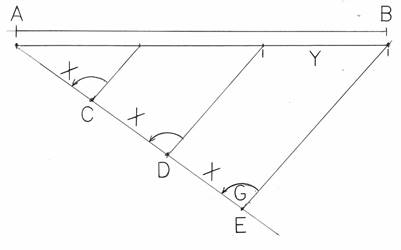
B) On the opposite lower ray, use the fixed compass to mark off three equal line lengths X: (A-C), (C-D), (D-E). Use the straightedge to construct a straight line from point B to point E. Let point E be the vertex of the angle to be reconstructed at points C and D. The two points where the reconstructed angle rays intersect with line A-B accomplish the goal of dividing A-B into 3 equal segments. Y (A-B)/3. This procedure could be used to construct the line length and ratio of (10/9) because we can consruct the ratio (10/3) in the tangent = (10/3) right triangle, then divide the line length of (10/3) into three equal segments that are each (10/9). But I believe using the 3,4,5 right triangle method is easier and more elegant.
2) Use the 3,4,5 right triangle trick to get the (10/9) line and ratio value:
A) Tangent (4/3) right triangle
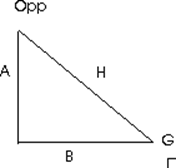 image78.gif
A = 4, B = 3, H = 5 G = 53.13010235 deg, rttri = Tan 1.333333333
Then: Reconstruct angle G, Tangent = 1.333333333, and then make
the Base B = (5/6) or 0.833333333
Raise perpendicular at left end point of Base B. A = (10/9) or 1.111111111,
and H^2 = 1.929012346 and H = 1.388888888.
B) Construct a square with side S = 1. Construct the diagonal. The diagonal is equal to sqrt(2) or 1.414213562. Use the compass and straightedge to double the diagonal. Or, of course, we could construct a square with side S = 2, and then the diagonal would be 2 times sqrt(2) which equals the sqrt(8) or 2.828427125.
C) From our 3,4,5 right triangle with Altitude A = 10/9, use the compass and straightedge to construct a new right triangle with tangent = (10/9). This we do simply by constructing perpendiculars making the Altitude A = (10/9) and the Base B equal to 1. Using our previous illustration, the base of this right triangle extends from the 90 degree vertex to the right. Construct the Hypotenuse from the end points of A and B. Illustration below:
C – rttri) [10/9] ) Tangent = (10/9) right triangle
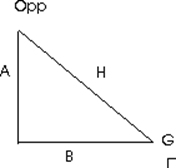 image78.gif
A = (10/9) or 1.111111111, B = 1, H = 1.494847116
G = 48.0127875 deg = Tan 1.111111111. Note that (10/9) = 1.234567901
D) Reconstruct the angle of interest (the lower right acute angle) from our tangent = (10/9) right triangle. Then use the compass to extend the lower ray or side of the angle to the length of sqrt(8) 2.828427125. From the left end point of that horizontal side B construct a perpendicular upward. That perpendicular intersects with the upper side of our reconstructed angle to complete a similar tangent 10/9 right triangle. Because we know that the tangent = 10/9, the length of Altitude A must be 3.142696805 because A/B = (10/9) and therefore A = B (2.828427125) times (10/9), which = 3.142696805.
We have successfully constructed the line length with numerical value = 3.142696805, which we will label as Pi*ZM, where ZM = 1.000351462.
Relationship of Golden Mean to Pi*ZM
From Pi*ZM to Golden Mean Progression:
sqrt(8) / 0.9 = 3.142696805, Pi * ZM, ZM = 1.000351462
3, sqd = 9, /10 = 0.9, sqd = 0.81, * 2 = 1.62, sqd = 2.6244
1.62 * (ZM^2 / HO^2), 1.62 * 0.998786412 = 1.618033988
2.6244 * (ZM^4 / HO^4) 2.6244 * 0.997574298 = 2.618033988