The Old Constructions useful for understanding SOLITUCOMP
by using old Constructions with the new knowledge:
1) Construction of a pentagon adding the self-reciprocal construction
2) Construction of Phi (1.618033988), phi = 0.618033988, and Phi^2 = 2.618033988
3) Construction of the ratio and multiplier 6/5, or 1.2, inverse 0.8333333333
4) Construction of Pi*MQ: 3.141640786
5) Construction of the square root of (0.618033988), = 0.786151377
6) Construction of Pi*HO (3.14460551) HO = HOLY
7) Construction of HO/MQ, MQ/HO, each squared
8) Construction of RA, Ratio A, the Hiram Key?
9) Construction of circle and square exactly equal in area; construction of pi exactly.
Standard right triangle:
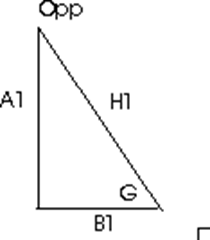 RT1std.gif
Standard right triangle 2, re reconstruction of angle and similar RT
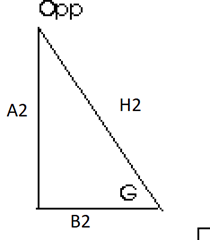 RT2std.gif
RT for construction of line that equals the tangent ratio. B = 1, A = Tan, or A = B*Tan
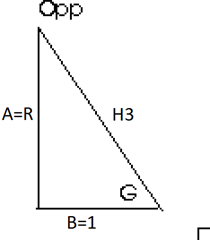 RTratioline.gif,
See SRT Tables
RTratioline.gif,
See SRT Tables
1) Construction of a pentagon, including the Phi-value ratios and lines:
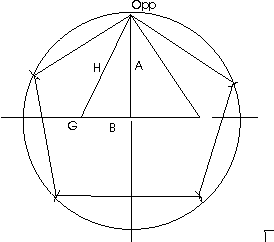 conpent02.jpg
From pentagon to 3654 RT – one tenth of 360 degrees = 36 degrees
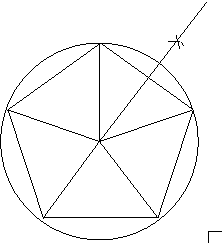 3654RT.gif
Construction of the five-pointed star inside a pentagon, aka pentangle:
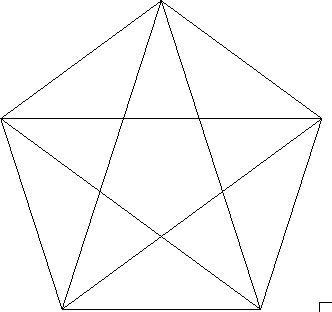 pentagonstar.gif
Square the rectangle, where by L x W =1 renders area of square equal to Side L
and therefore the constructed side of the square = sqrt(L). This common construction could therefore be called the "Square Root Construction":
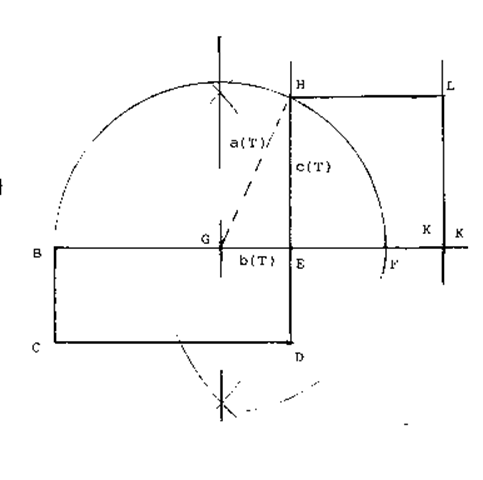 squarerectsqrt.gif
Proportional area of outer square and inner circle:
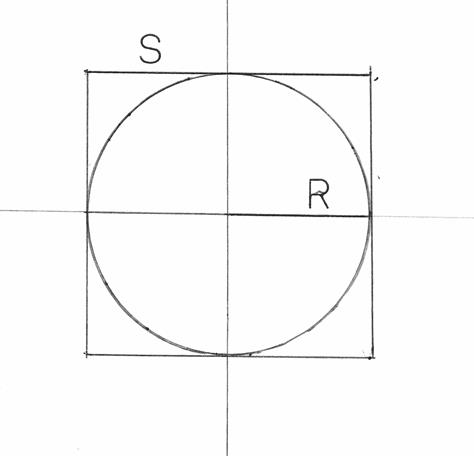 proparea1.jpg
AS = AC * (4/pi) If AC equals AS exactly, then S/R = sqrt(pi) exactly.
Construction of Pi*MQ lines:
SOLITUT is a table of contents for the before 2022 SOLITU series
SOLITUD or SOLITU-D includes detailed descriptions of common geometrical and trigonometrical constructions. We will use reconstruction of a given angle, construction of a similar right triangle, construction of a ratio as the numerical length of a line, construction of a square root, also known as "squaring a rectangle," construction of a pentagon and pentangle, construction of the reciprocal of a number or the self-reciprocal construction, and then the proportional areas — a circle in a tangent square.
SOLITUH or SOLITU-H, first posted in 2015, is where I suspected that the self-reciprocal construction was the Hiram Key. I have since revised by viewpoint and now suspect that the complete positive solution of the Pythagorean Riddle, presented here as SOLITUCOMP, is most likely to be the Hiram Key, because it not only reveals the solution to the riddle, but accomplishes the purpose of revealing the meaning of proportion in the universe as a fundamental force itself rather than the outcome of another set of forces or causes. In other words, as I searched endlessly for the means to construct pi exactly as a straight line, I unavoidably discovered an image of proportion as THE PRIMAL CAUSE. This makes natural proportion the cause of the physical forms of the material universe and the cause of the evolution of life. That interpretation of "natural proportion" supports a rational and scientific conclusion that natural proportion is the Secret of Life in the Universe (SOLITU).
Unique character of Phi (1.618033988) and MQ (1.000015321)
The Special Numbers
The complete solution to the ancient Pythagorean riddle
begins with seeing, or at least observing,
a set of five special numerical values:
Special (Defined) Numbers:
Phi, MQ, (Pi*MQ), HO, (Pi*HO) and Pi and RA or "Ratio A"
[I did not ever see the definition of MQ or Pi*HO in any source
before I observed them in my own research 1980 – 2020.]]
Definitions of the pertinent numbers:
The number Phi is equal to 1.618033988 or 1.618033989 (depending on one's application of rounding) and is called the Golden Mean, Golden Ratio or Golden Section. Labelled as "Phi" or the Greek letter f , and pronounced either as "fie" or "fee" (disputed), is a unique number value because it complies with a unique numerical definition, or set of definitions.
Phi = 1.618033988, Phi^2 = 2.618033988 or Phi + 1
Phi, 1.618033988 is the infinite sum of the Fibonacci series, or the Past-additive
Series (I abhor naming natural processes after a person). We do not know who was the first to discover anything. The Past-additive series is: 0, 0+1=1, 1+1=2, 2+1=3, 3+2=5, 5+3=8, 8+5=13, 13+8=21, and so on. To check out the definition just continue the series: for example 21/13 = 1.615384615. Then 34/21 = 1.619047619 and 55/34 = 1.617647059. Each new ratio will fall first below 1.618033988 and then greater than
1.618033988. The "infinite" sum is 1.618033988 et cetera, endless decimal.
Back again to the definitions of these special numbers:
Definition of Phi:
Phi = 1.618033988, Phi^2 = 2.618033988 or Phi + 1
1/Phi = 0.618033988 or "phi" for "little phi" meaning Phi – 1
little phi^2 = 0.381966011 [0.618033988]^2 also = to 1/Phi^2
Phi = 1.618033988 or 2 * 0.809016994 or 2 * (cosine 36)
and little phi 0.618033988 = 2 * 0.309016994, (or 2 * sine 18)
and further 3 – 0.381966011 = Phi^2 or 2.618033988, and further
1/3.618033988 = 0.276393202 which = (secant 18)^2 / 4
Phi + (1/Phi) = sqrt(5) 2.236067977
Transition from Phi to Phi^2 * (6/5) = Pi*MQ
2.618033988 * (6/5) = 3.141640786 or (Pi*MQ)
Where Pi = 3.141592653 or 3.14159654, which makes
our MQ value = 1.000015321 which has its own unique definition.
Definition of MQ:
MQ = 1.000015321, and MQ * 2 = MQ^2 + 1
Note that is different from Phi + 1 = Phi^2 (actually kind of the opposite)
Further: (MQ + 1) / 2 = sqrt(MQ)
and MQ + 1/MQ = 2 (1.000015321 + 0.999984679)
One is the only other number that fits these definitions of MQ.
Definition of HO:
(Pi*HO) = 3.14460551, HO = 1.00095922
4/ (Pi*HO) = sqrt(Phi), or sqrt(1.618033988)
4/Pi = HO * sqrt(Phi), HO = 4 / [Pi * sqrt(Phi)]
RA or Ratio A: 1.030056648 … is
(sine 18) or 0.309016994, or phi/2 [0.618033988/2] times (10/3) or phi * (5/3)
or (sqrt(5) -1) (1.236067977) times (5/6), each and all = 1.030056648, which turns out to be a kind of magical number or ratio that yields surprising results when employed as a factor in the construction or computation of new ratios. Some of such new ratios, such as those shown in the tables of ratios and "pi lines," reveal a fascinating (to me) process of extending the "pi lines" to larger values that include pi lines and Ratio A as factors. If you enjoy playing with ratios, you will enjoy RA, RA^2, RA^3, RA^4.
Construction of HO/MQ:
Before one might ever have explored Phi, Phi^2 and Pi*MQ, we were all taught that Pi (or pi, p ) [as in apple, blueberry or pumpkin] is the fixed distance between two points (each point having no dimensions) that enables us to construct the circumference of a circle around the fixed center point. What I present as new here is that by using the ability to construct (MQ/HO) we can construct squares and circles exactly equal in area.
Right here is a good place to point out that I do not claim that there is any new, tricky or special construction with the compass and straightedge, but I show the use of common construction steps which, due to a new understanding of natural proportion, enables the positive solution.
PART 1: INITIAL STEPS TO ESTABLISH A LINE LENGTH OF 1
Initial steps in construction of the pentagon:
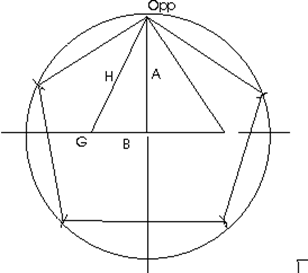 conpent02.jpg
A = 2 = radius of the circle, and the base of the initial right triangle in the upper right quadrant of the circle would be one-half of the radius, or 1 (not to scale in this drawing), and of course that hypotenuse = sqrt(4 + 1) our famous 2.236067977 sqrt(5)
When we construct the 36-54 degree right triangle (within the pentagon below)
[360/5 = 72, divided in half, = 36 degrees, the opposite angle = 54 degrees.]
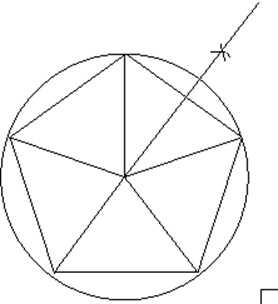 conpent03.jpg
the ratios of the sides, where H = 1, are:
A: (sine 54) 0.809016994, B = (cosine 54) = 0.587785252
here angle G = 54 degrees, and this is RT Tan = 1.37638192
RT1std.gif
However, when we take the first steps to construct the pentagon, the radius of the circle is 2, and that length of 2 also serves as the "H" in the 36-54 degree right triangle that we find in the pentangle later. With the length of H1 being 2, the length of A1 is 1.618033988, and the length of B1 is 1.175570505. A1^2 = 2.618033988, and B1^2 = 1.381966011, and A^2 + B^2 = 4, of course, which makes H = 2 as we already know. Are all these ratios, and innumerable others, just a coincidence? Just an outcome of numbers or our decimal number system? I believe that there is more than one reason why a decimal number system is "natural." For example, it is 2 times 5, and the proportions of the natural physical world are embodied in 2 and 5. To me, the design of proportion, the original force called "proportion," is a pattern visible in the ratios of numbers (trigonometry). I do not deny that this viewpoint can be labelled as "numerology," and discredited just as "astrology" is discredited. But astrology implies influence from a distance, and the academics in the field of physics struggle constantly with the evidence that influence at a distance does exist, however subtle it may seem. I acknowledge that if one sees a pattern where there is none, that is a type of mental illness; and if one sees a pattern where there is a pattern, that is science.
Square Root of Phi
All we need to do is construct a rectangle with two parallel lengths equal to Phi, and the two parallel sides with length of 1. That rectangle has an area of Phi 1.618033988. We use the "square the rectangle" procedure, using only the compass and straightedge, and the result is a square with the same area of Phi 1.618033988. Therefore, the length of the side according to the axioms of geometry is the square root of Phi 1.27201965.
When we perform the self-reciprocal construction, and then superimpose it on the original first steps for the pentagon, we see that the original construction of the pentagon encompasses the "natural one" value of the Base B (one half of the radius), such that the numerical value of 1 for the Base – in relation to all the other line lengths, is natural in origin and not arbitrary. This is argued in detail in SOLITUH.
Having completed the initial steps to construct the pentagon, we have constructed the hypotenuse of the Tan 2 right triangle, which is the square root of five or 2.236067977, and we have constructed the square root of 5 minus 1, or 1.236067977. Obviously, we can readily construct 3.236067977 also.
We have constructed line values of 1.236067977, 2.236067977 and 3.236067977,
And we can readily construct 4.236067977 and the inverse 0.236067977
HKSR2 or self-reciprocal construction
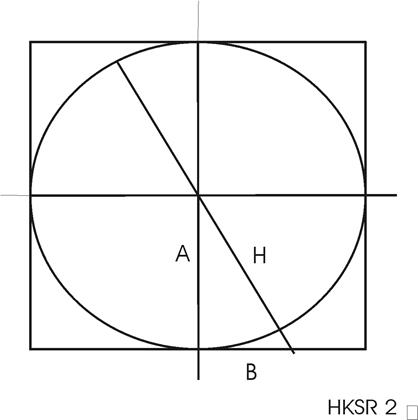 HKSR2.gif
In the self-reciprocal construction, the angle in the lower right (not the corner of the square) is always greater than 45 degrees and less than 90 degrees. The numerical value of Base B is always equal to 1 in relation to Altitude A and Hypotenuse H. H is if course always the square root of A^2 + B^2. If we designate the label "X" for the diagonal straight line that continues line H from the center of the circle up to the upper left point on the circumference of the circle, running downward to a point on the base of the lower right quadrant, then that line X is equal to A (the radius) plus H (the hypotenuse). Then, the shortest line that extends on line X from the lower right point on the circumference of the circle downward to the right point on the base of the quadrant of the square, THEN that line could be labelled "RP" and that line is always the reciprocal of X. This is in fact a trigonometric function, meaning it is always true if the angle falls between 45 and 90 degrees.
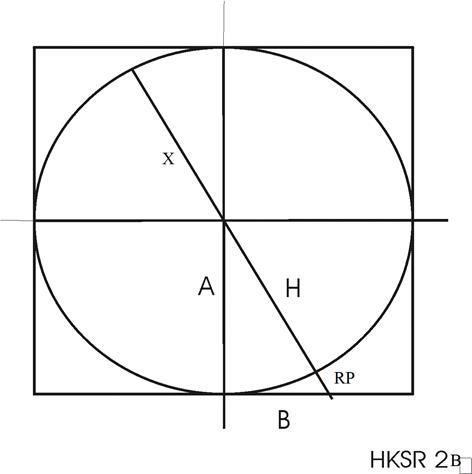 HKSR2B.gif
To clarify, the angle of interest in the right triangle A, B, H in the lower right of ABH is always 45 > 90 degrees, and the length of RP is always the reciprocal of X. This trigonometric function may be new to many geometers, as it was to me, but I do not claim to have discovered this geometric fact simply because I strongly suspect it was previously known, although I had never found it before in a geometric source.
The self-reciprocal construction superimposed on the start for the pentagon:
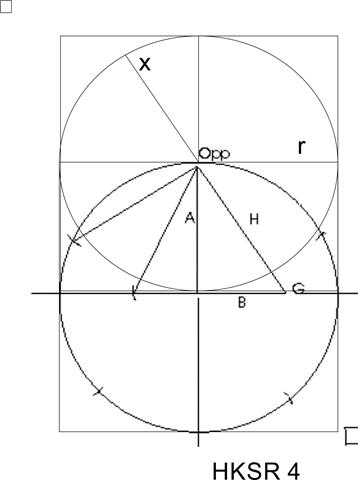 HKSR4.jpg
The upper circle is the self-reciprocal construction. The original base B for the pentagon, which is one-half of the radius, is naturally the numerical value 1 in relation to all other lines in the construction and subsequent proportional constructions.
The Meaning of Proportion in a Box of Apples
There are a seemingly infinite number of interesting ratios that make up the world of proportion when we think of proportion as a distinct force imprinted on matter, or embedded in matter, rather than as the result of a number system. The effect of proportion is like a box of apples before the imprint of the force of proportion – it is just a box of apples. The apples could be numbered. But after the force of proportion is applied, which I believe is the event that causes the "Big Bang" theorized by Professor Stephen Hawking, the apples are assembled into a distinct matrix as though each apple is pierced by a bamboo stick and constructs a specific matrix or three-dimensional structure which thereafter directs the shapes and forms of all matter in the universe. It is like a specific arrangement of apples and sticks. It is like a person who was selecting a wallpaper design from a large sampling of wallpaper designs and they chose one. It is a specific design, like paisley #5, and there is no scientific explanation or precursor or antecedent that can be identified. For us to ask the question: "Why is Nature organized this way?" is the same as asking the question: "Why is there something instead of nothing?" or "Why does the universe exist?" The beginning is a terminus.
Note that the Fibonacci series generates 1.618033988 found in living things:
1, 1+1, 2+1, 3+2, 5+3, 8+5, 13+8, etc. and 5 and 6 (flower petals, stamens, etc)
Pi is generated by two points that remain equidistant while moving together as though the two points are a single unit. The distanced traversed as one point revolves around the other is always 2 times the length of the radius times pi, or pi times the diameter of the circle that is traversed when we treat one point as central or in a fixed position.
When we construct a circle showing the radius and diameter, and then construct four tangent sides, equal in length which generates an "outer" square tangent to the circle, the area of the outer square is always 4/pi times the area of the inner circle. The circle and area have the same center point. In reverse, the area of the inner circle is always pi/4 times the area of the outer square.
This fixed proportion is central to our ability to construct pi as a straight line. The other crucial principles that enable us to construct pi as a straight line are A) the fact – startling to beginners – is that trigonometric number values and the natural number values can be written as always including the numerical value of Pi*MQ or 3.141640786
And now, in the center ring, we look at how we construct the ratios (such as tangents) and right triangles and rectangles and squares and circles and most of all lines that have a distinctive, and unquestionable numerical length, using only the compass and straightedge.
PART 2: STEPS FOR THE CONSTRUCTION OF pi EXACTLY:
2) Construction of Phi 1.618033988 and Phi^2 already present in the pentagon.
When we constructed the 36-54 right triangle, with H = 2,
we already had RT Tan = 1.37638192 where A = 1.618033988
36-54 RT Tan = 1.37638192 3654RT.gif
A1 = 1.618033988, B1 = 1.175570505, H1 = 2
Angle G = 54 degrees
Using compass, add value of 1 to line A, result is 2.618033988, or Phi^2
with this unique number, Phi^2 = Phi +1. This is false for all other numbers.
Square Root of Phi
All we need to do is construct a rectangle with two parallel lengths equal to Phi, and the two parallel sides with length of 1. That rectangle has an area of Phi 1.618033988. We use the "square the rectangle" procedure, using only the compass and straightedge, and the result is a square with the same area of Phi 1.618033988. Therefore, the length of the side according to the axioms of geometry is the square root of Phi 1.27201965.
We have line lengths of 2, 1 (one), 1.618033988 and 2.618033988 and the square root (sqrt) of Phi 1.27201965.
3) Construction of Pi*MQ (6/5 times Phi^2)
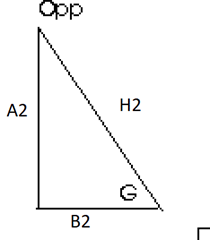 RT Tan = 1.2 RT2std.gif
A2 = 6, B2 = 5, H = 7.810249676
Angle G = 50.19442891 degrees
Reconstruction angle G as in RT Tan = 1.2 above (#2) and use the compass and straightedge to have Base B be the length of 1. Construct the perpendicular for side A.
Side A therefore has numerical line length of 1.2 (A/B = 1.2).
RT Tan = 1.2 with Base B = 1
A = Ratio = 1.2 B = 1 H3 = 1.562049935
Angle G = 50.19442891 degrees Opp = 39.80557109 degrees
Therefore, here with RT Tan = 1.2 constructed in a similar right triangle with Base 1, we have constructed the line length of A = 1.2
We have line length of 1.2
NOTE THAT WE ARE USING ONLY THE COMPASS AND STRAIGHEDGE TO RECONSTRUCT ANGLES AND CONSTRUCT SIMILAR RIGHT TRIANGLES. WE ARE NEVER USING A "PROTRACTOR" TO MEASURE AN ANGLE OR A SCALE ON A "RULER" TO MEASURE THE LENGTH OF A LINE. THE AXIOMS OF GEOMETRY AND TRIGONOMETRY TELL US THE TRIOGONOMETRIC RATIOS AND LINE LENGTHS THAT RESULT FROM OUR CONSTRUCTIONS USING ONLY THE COMPASS AND STRAIGHTEDGE. Angle sizes and ratios are indicated here only to enable quick verification with a calculator. By strict construction rules, each right triangle can be designated solely by the angle's tangent ratio.
4) Construction of Pi*MQ
Next, we reconstruct Angle G to include an extended horizontal base line B and an extended upper side that will become the hypotenuse H. Using the compass we open the compass to our line length of Phi^2 or 2.618033988. Then, at the leftward endpoint of Base B = 2.618033988 we reconstruct a vertical perpendicular. We now have a new right triangle that is still similar to RT Tan = 1.2, and therefore we have the following new side lengths:
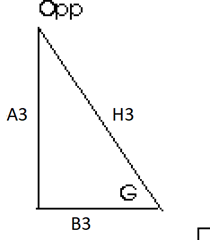 Reconstruction that
accomplishes a multiplication
Reconstruction that
accomplishes a multiplication
of a line length times the tangent ratio. RT3std.gif
B = Phi^2 or 2.618033988 A = Phi^2 * 1.2 or 3.141640786
We still have Angle G = 50.19442891 degrees, RT = Tan = 1.2, BUT ALSO
We have line length of Pi*MQ or 3.141640786
I used a calculator to find the value of MQ (1.000015321) but that is a violation of the rules. How could the Pythagoreans know this value? We will see the most likely explanation later, when we complete the solution to the riddle USING ONLY THE COMPASS AND STRAIGHTEDGE.
Again: MQ + 1/MQ = 2 (1.000015321 + 0.999984679) MQ^2 + 1 = 2 * MQ
5) Construction of sqrt(0.618033988), 0.786151377
6) Construction of Pi*HO
Pi*HO is a second pi-line, a companion, sibling, or partner as one would propose, that enables us to construct pi exactly. For Pi*HO, we simply use the square root of phi, which = sqrt(0.6180339888). Pi*HO = 4 * 0.786151377, or 4 * sqrt(0.618033988). Therefore (Pi*HO) = 3.144605511, and (Pi*MQ)/(Pi*HO) = 0.999057203. Suggests a long journey through many ratios but not to the solution yet.
Next: we need to meet a couple of new numbers. Others will be listed below in an abbreviated table of "Pi*MQ" number values. The new number value that we will use is 1.030056648 and I have named it RA – for Ratio A.
I have given letter names to other ratios, such as TN = (secant 18)^4 divided by (11/9).
(secant 18)^4 = 1.222291236, divided by 1.222222… = 1.000056466 = TN. Such that Pi*MQ*TN = 3.14181818181, as in 1.81818181*1,2 … check it out, and you might begin to see what I see. Try * 1.2, * 1.2 * 1.2 Note that 1.818181818 = (100/55). The value TN is a factor is several pi lines in the table further below. (1.2)^3 = 1.728.
Let's get back to the main program. To complete our process we need to construct more specific line lengths, such as: 1.030056648. I named this line "RA" as in "Ratio A." Whatever. It is easy to construct. RA = (sqrt(5)-1) times (5/6) or 6.180339887 divided by 6: 1.030056648. We can see that it is the same as (1/Phi) or 0.618033988 multiplied by 10 and divided by 6, or the sine of 18 degrees (0.309016994) times (10/3). Okay.
NEXT: a review of our line value inventory:
We have line lengths of 2, 1 (one), 1.618033988 and 2.618033988 and the square root (sqrt) of Phi 1.27201965.
We have line length of 1.2 (also the inverse ratio/line (5/6) or 0.8333333333).
We have line length of Pi*MQ or 3.141640786
We have constructed line values of 1.236067977, 2.236067977 and 3.236067977,
And we can readily construct 4.236067977 and the inverse 0.236067977
*****
Let's examine the various comparisons or ratios that involve Pi*MQ and Pi*HO.
Construction of Pi*HO:
We can start from many different points. Let's take our line 1.618033988, which we have from our inventory from construction of the pentagon. Use the compass to subtract the length of 1. Then open the compass to 0.618033988 and proceed to construct a rectangle with parallel sides of 0.618033988 and 1. Then follow the steps for the "square the rectangle" construction. The resulting square has an area of 0.618033988, which means the length of the side must be the square root of 0.618033988, or 0.786151377. Open the compass to that side length and mark it twice on a straight line. Then open the compass again to that length of 2 * 0.786151377. Then on a longer straight line use the compass to mark off the length of 4 * 0.786151377, which is 3.1446055110. That is our "pi-line" which I have labelled as "Pi*HO." HO = 1.000959022.
We have constructed 3.1446055110, and by means of our calculator we know that number is the product of pi exactly and 1.000959022 which I have labelled as HO. We cannot at this time construct a line length of HO, but we can use our calculator to see that HO is not like MQ. HO + (1/HO) does not equal 2.
When I was making up name labels for these numerical values in the 1990s, I chose "MQ" as the abbreviation for "Magic Quotient," and "HO" as abbreviation for "Holy Ghost." That's why I labelled the inverse of HO "GH or Gh."
7) Construction (HO/MQ), (MQ/HO), each squared
Construct a right triangle with Altitude A = (Pi*HO and Base B = (Pi*MQ). We now have right triangle with tangent = (HO/MQ), or 1.00094367. Reconstruct the acute angle G and then use the compass to make a Base B equal to 1. Because the tangent of this new right triangle with Base = 1 must be equal to (HO/MQ), that means the length of Altitude A must be (HO/MQ). Next we reconstruct the acute angle G again, and use our compass to make the Base B equal to (HO/MQ). Because the tangent is known to be (HO/MQ), then the numerical value of our new Altitude A must be (HO/MQ)^2, same as (HO^2/MQ^2), or 1.001888264.
We have constructed lines for (HO/MQ) 1.00094367, and (HO^2/MQ^2) 1.00188264 and can add them to our inventory of lines.
We then do the same for construction of the ratio (MQ/HO) by starting with a right triangle with A = PI*MQ and B = Pi*HO.
Completing similar steps, we have constructed lines for (MQ/HO), 0.999057203, and (MQ^2/HO^2), 0.998115294, and can add them to our inventory of lines.
*******
8) Construction of RA 1.030056648. Is this number the Hiram Key?
For our next task, we will construct the number value that may be the Hiram Key, 1.030056648 which I have labelled RA for "Ratio A."
View the next drawing or construction (not to precise scale in the image)
Image133.gif Drawing for RA construction:
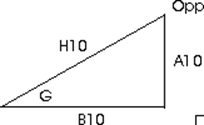 A right triangle
with the angle of interest being the lower left acute angle G. We use our
compass and straightedge to construct the right angle at the lower right. Then
we mark off the height A10 for an altitude of 5, and we mark off the lower
horizontal side for a base of 6. This means angle G is necessarily the angle
that produces tangent = (5/6) and this right triangle is the rt tri tan
0.8333333333. One can perform a check using a calculator or other geometric
source to establish that the angle G is 39.80557109 degrees. The length of H10
between the two end points is sqrt(61).
A right triangle
with the angle of interest being the lower left acute angle G. We use our
compass and straightedge to construct the right angle at the lower right. Then
we mark off the height A10 for an altitude of 5, and we mark off the lower
horizontal side for a base of 6. This means angle G is necessarily the angle
that produces tangent = (5/6) and this right triangle is the rt tri tan
0.8333333333. One can perform a check using a calculator or other geometric
source to establish that the angle G is 39.80557109 degrees. The length of H10
between the two end points is sqrt(61).
We then reconstruct angle G but instead of using our compass and straightedge to make the horizontal base 6, we borrow the line length of 1.236067977 [sqrt(5) – 1] from our previous construction and mark off the base length of 1.236067977. We can then construct the new H10 hypotenuse but it is not necessary to do so. The ratio of the new altitude to the new base is still (5/6) according to the axioms of trigonometry, and therefore A10/B10 = A10/ 1.236067977 = (5/6), or A10 = 1.236067977 * (5/6), which we see does equal our RA value of 1.030056648.
We have constructed numerical value RA 1.030056648.
Next we construct a right triangle with Altitude A = RA and Base B = 1. The tangent of our new right triangle is equal to RA/1 = 1.030056648. "Image78 below" With the angle of interest G at the lower right.
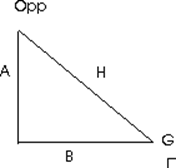 Image78.gif
We then reconstruct the angle G with our compass and straightedge, extending each arm of the acute angle approximately the same length with the upper sloped side made a bit longer than the base. We use our compass and straightgedge to mark off the Base B length of RA (1.030056648) from the right vertex to the left end point. We then "raise a perpendicular" at the left end point of our Base B resulting in our new similar right triangle with the same tangent (for angle G) [which is 45.84824887 degrees if measured].
We know that the tangent of our reconstructed right triangle is 1.030056648. Therefore (A/B) = 1.030056648 and B equals the numerical line length that we already constructed, which is 1.030056648. Therefore, to comply with the necessity that the tangent is still 1.030056648, our new altitude A must have the length of RA^2 or 1.061016698. As one can see 1.061016698/1.030056648 = 1.030056648.
We have constructed numerical value RA^2 1.061016698.
Now we are getting near to the "magical" quality of RA that enables construction of squares and circles exactly equal in area. Our next step is to construct RA^4 (1.125756433), which we know equals RA^2 * RA^2. To accomplish this we simply replicate the procedure we used to construct RA^2 except that we begin with a new right triangle with Altitude A equal to RA^2 and Base B equal to 1.
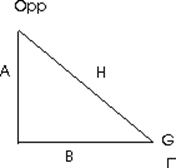 Image78.gif
Thus, in this new right triangle, we begin constructing a right angle at the lower left, and then we use our compass and straightedge to mark off the length of our new Altitude A as our line length of RA^2, 1.061016698, and our Base B as our same old 1. We then connect with the straightedge our new Hypotenuse from the upper end point of A to our lower right end point of B. We now have a new rt tri with Tangent = 1.061016698. By now many have got the picture of what is going on here and we know that our next step is to reconstruct our new angle G (Tangent = 1.061016698 – aka 46.69575455 degrees) in a new drawing space with the vertex of angle G to the right on a horizontal base line. Then we use our compass and straightedge to mark the length of our new Base B as 1.061016698. And then, at that left end point of our new Base B we "raise a perpendicular" extended upward to the upper side of our reconstructed angle G. We know that with our angle G = Tangent 1.061016698 the tangent of this new right triangle (A/B) must be 1.061016698, or 1.125756433 / 1.061016698. Our new Altitude A is now 1.125756433.
We have constructed the line length of RA^4 which = 1.125756433.
By the way, by now all who have come this far should see clearly that the ancient geometers did not need to measure angular distance, such as degrees or radians or anything other than the lengths of straight lines, with the compass and straightedge, because all angles can be identified by their ratios: sine, cosine, tangent, secant, cosecant, cotangent.
(On page link: )
NEXT: a second review of our line value inventory:
We have line lengths of 2, 1 (one), 1.618033988 and 2.618033988
and the square root (sqrt) of Phi 1.27201965.
We construct 0.809016994 (cosine 36) by dividing 1.618033988 in half
We have line length of 1.2 (also the inverse ratio/line (5/6) or 0.8333333333).
We have line length of Pi*MQ or 3.141640786
We have constructed line values of 1.236067977, 2.236067977 and 3.236067977,
And we can readily construct 4.236067977 and the inverse 0.236067977
We have constructed 3.1446055110, and by means of our calculator we know that number is the product of pi exactly and 1.000959022 which I have labelled as HO.
We have constructed lines for (HO/MQ) 1.00094367, and (HO^2/MQ^2) 1.00188264
We have constructed (MQ/HO), 0.999057203, and (MQ^2/HO^2), 0.998115294
We have constructed numerical value RA 1.030056648.
We have constructed numerical value RA^2 1.061016698.
We have constructed the line length of RA^4 which = 1.125756433.
Note that we can also construct the "55 Series":
Observe the seemingly magical quality of secant (18)^4. The scientific proposal that is extremely important here is that this is not "numerology" or simply "sacred geometry." If the geometry is "sacred," really, then that might be because "proportion is everything," and proportion is a distinct matrix that is the embodiment of the most fundamental force in the universe, namely "proportion." That conclusion, if correct, would mean that the "forces" we have discovered or suspected thus far: gravity, electro magnetism, the strong force, the weak force, plasma, and whatever, are all subtle manifestations of the original creation by proportion. Anyway, all constructible are the values as follows: cosine (18) = 0.951056516, (inverse) secant (18) = 1.051462224. Secant (18)^2 = 1.105572809, and secant (18)^4 = 1.222291236. Then 1.222291236 times 9 = 11.00062112, and 11.00062112 divided by 11 = 1.000056466, our value TN. We have multiplied the secant of 18, raised to the fourth power, by (9/11) or 0.8181818181, which is the inverse of 1.2222222222. This value, 1.000056466, appears repeatedly in the 55 Series and in our table of pi lines. Watch: 0.55 (the 55 Series) means 0.55, or (55/100). The inverse, (100/55) = 1.8181818181, which is obviously our (9/11) plus one. And the 55 Series is as follows: 1.818181818181, times (6/5) = 2.181818181818 et cetera …
1.818181818181, times (6/5) = 2.181818181818
2.181818181818, times (6/5) = 2.618181818181 = 2.618033988 x 1.000056466
2.618181818181, times (6/5) = 3.141818181818 = pi x MQ x 1,000056466
3.141818181818, times (6/5) = 3.770181818181 and also
(Phi)^2 or 2.618033988, x 1.222291236 = 3.2 ... is it all meaningless numerology?
Or part of the pattern of Natural Proportion? The truly universal meaning of number?
SOLITU COMP presents last steps in constructions, following accumulation of related construction experience (above): Here below I show constructions using only the compass and straightedge, and of course using our inventory of line lengths, all in proportion to our original established 1.